Tell us about the job
Takes about a minute. No obligation.
A boiler repair quote in Finney County starts at the burner and ignition system, because those are the parts that cycle every time the boiler fires and accumulate wear faster than anything else in the unit. Homes in Finney County, KS run heat about seven months a year, from October through April. The heat exchanger takes that same load, and a contractor opening a boiler here checks it for fatigue cracks before moving to secondary components. Corrosion in the system water and sediment at the bottom of the vessel are the other findings that show up after years of steady cycling.
Boilers old enough to be common in this housing stock sit in a narrow window where they still run but replacement parts grow harder to source with each passing season. Half the homes in Finney County, Kansas were built in 1978 or earlier (2020-2024 ACS 5-year). A contractor opening a unit here has to establish not just what failed, but whether what failed can still be ordered, and from where. If the part is discontinued, the repair conversation shifts into different territory before the job is priced.
The Parts of a Boiler a Contractor Checks First
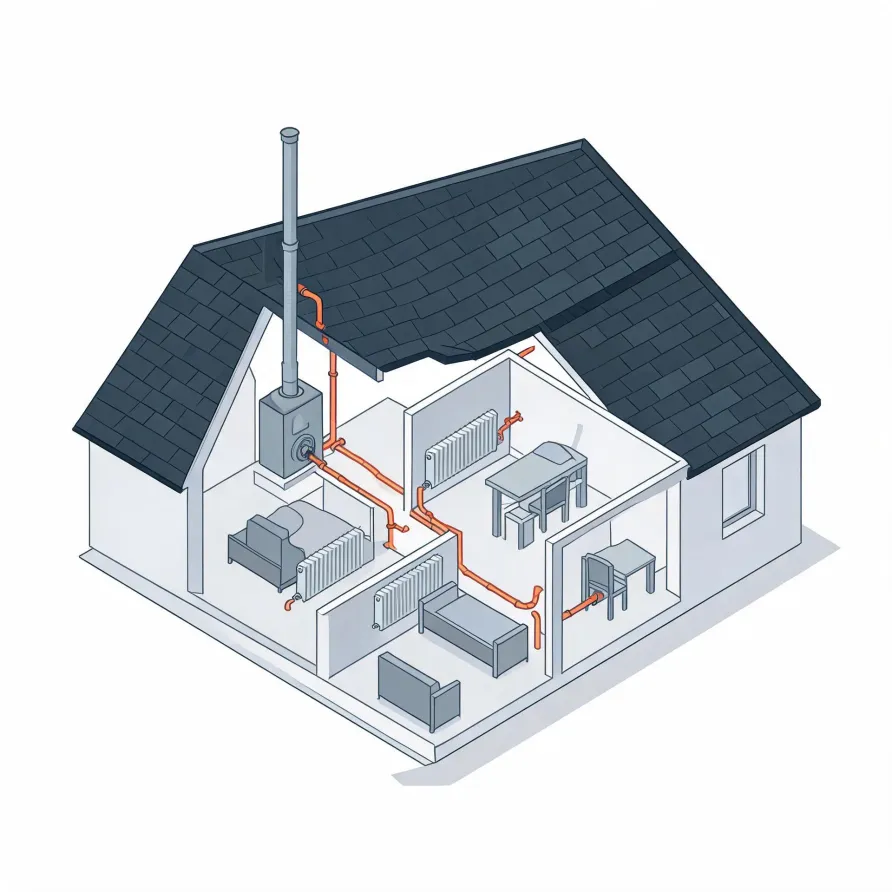
The boiler itself sits in the basement or a utility room and is the piece a contractor goes to first. It heats water and pushes it through the system. When a boiler runs short cycles, loses pressure, or stops producing heat altogether, the fault usually lives here, in the heat exchanger, the burner, or the pressure relief valve.
Radiators or baseboard units sit throughout the living space and release heat into each room. Connecting them to the boiler are supply and return pipes, along with a circulator pump that keeps the water moving. A stuck pump, a faulty zone valve, or a radiator that stays cold while others warm up points a contractor toward this part of the system.
The drawing shows a typical boiler layout, and a licensed contractor determines which components apply to your specific home.
Find a contractor in Finney CountyFinney County, by the numbers
363 severe weather events were recorded in Finney County, Kansas between 2015 and 2024.
NOAA National Centers for Environmental Information, Storm Events Database, bulk CSV export, events 2015-01-01 through 2024-12-31.Half the homes in Finney County, Kansas were built in 1978 or earlier (2020-2024 ACS 5-year).
U.S. Census Bureau, 2020-2024 American Community Survey 5-Year EstimatesFinney County, Kansas holds 14,355 housing units (2020-2024 ACS 5-year).
U.S. Census Bureau, 2020-2024 American Community Survey 5-Year EstimatesOwners occupy 64.9% of the occupied homes in Finney County, Kansas (2020-2024 ACS 5-year).
U.S. Census Bureau, 2020-2024 American Community Survey 5-Year EstimatesSevere Weather Events in Finney County
Finney County weather puts real load on boiler systems: pressure swings, hard freezes, and sudden temperature shifts stress components that already work hard through a Kansas winter. How much a boiler is tested by local conditions shapes how often it needs attention, which is why this data belongs on a page about repair.
363 severe weather events, 2015–2024. Source: NOAA National Centers for Environmental Information, Storm Events Database.