Tell us about the job
Takes about a minute. No obligation.
A boiler repair quote in Graham County starts with what the burner and ignition system have already been through. Homes in Graham County, KS run heat about eight months a year, from October through May. Cycling on and off across those months stresses the ignition assembly and heat exchanger far more than the parts that sit idle. A contractor inspecting a boiler here checks the igniter, the burner ports, and the heat exchanger for fatigue before moving to secondary components, because that is where the load lands.
Boiler repair in housing this old rarely goes the way a visual inspection suggests it will. Half the homes in Graham County, Kansas were built in 1957 or earlier (2020-2024 ACS 5-year). That means a contractor opening a boiler here is likely to find distribution lines that have been adapted, rerun, or capped off as the original heating plant changed over the decades. A zone that looks intact from outside may feed baseboards plumbed for a pressure and temperature the current unit was never set to match. What a contractor has to verify, before any repair makes sense, is what the circuit actually does now.
The Parts of a Boiler a Contractor Checks During a Repair
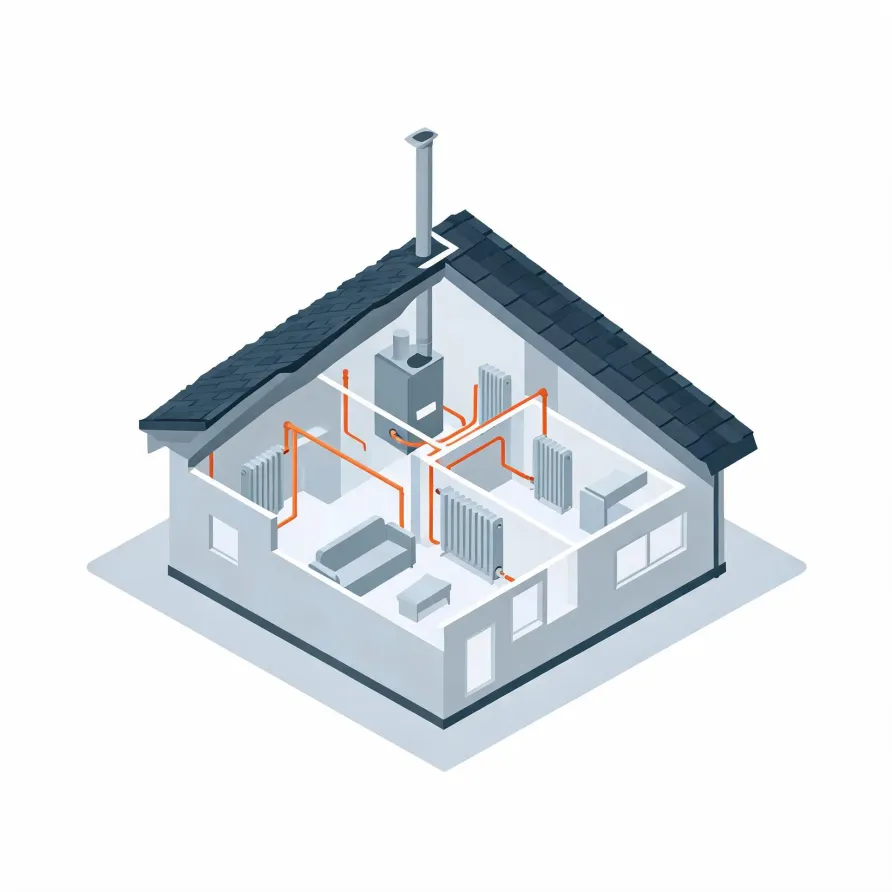
The boiler itself sits in the basement or a mechanical room and is the unit that heats water for the whole system. When it malfunctions, a contractor looks at the heat exchanger, the burner, and the pressure vessel first. A failed burner or a cracked heat exchanger is often where a heating problem starts.
The circulator pump moves heated water out through the pipes to radiators or baseboard units around the house. The expansion tank, usually mounted near the boiler, absorbs pressure changes as water heats and cools. The thermostat and zone valves, which control where heat goes and when, are also on a contractor's checklist when a zone stops responding.
The drawing shows the general layout of a boiler system, and a licensed contractor determines which components apply to your specific house.
Find a contractor in Graham CountyGraham County by the numbers
216 severe weather events were recorded in Graham County, Kansas between 2015 and 2024.
NOAA National Centers for Environmental Information, Storm Events Database, bulk CSV export, events 2015-01-01 through 2024-12-31.Half the homes in Graham County, Kansas were built in 1957 or earlier (2020-2024 ACS 5-year).
U.S. Census Bureau, 2020-2024 American Community Survey 5-Year EstimatesGraham County, Kansas holds 1,415 housing units (2020-2024 ACS 5-year).
U.S. Census Bureau, 2020-2024 American Community Survey 5-Year EstimatesOwners occupy 78.8% of the occupied homes in Graham County, Kansas (2020-2024 ACS 5-year).
U.S. Census Bureau, 2020-2024 American Community Survey 5-Year EstimatesSevere Weather Events in Graham County
Weather puts real stress on boiler systems, and that stress is local. Knowing the pressure the climate places on equipment here is part of understanding what repair and maintenance work in Graham County actually looks like.
216 severe weather events, 2015–2024. Source: NOAA National Centers for Environmental Information, Storm Events Database.