Tell us about the job
Takes about a minute. No obligation.
Sizing a boiler for this county starts with what the burner and heat exchanger are actually being asked to carry across the calendar. Homes in Osage County, KS run heat about seven months a year, from October through April. A burner cycling through that span accumulates ignition cycles, thermal stress on the heat exchanger, and wear on every seal and fitting that contracts and expands with each call for heat. A system that is undersized, or installed without careful attention to combustion setup and distribution, reaches that accumulated wear faster because idle time does not offset it. A contractor quoting a new boiler here has to work out the right output for the house before anything else, because an undersized unit runs longer per cycle to meet the load, and the heat exchanger pays that cost.
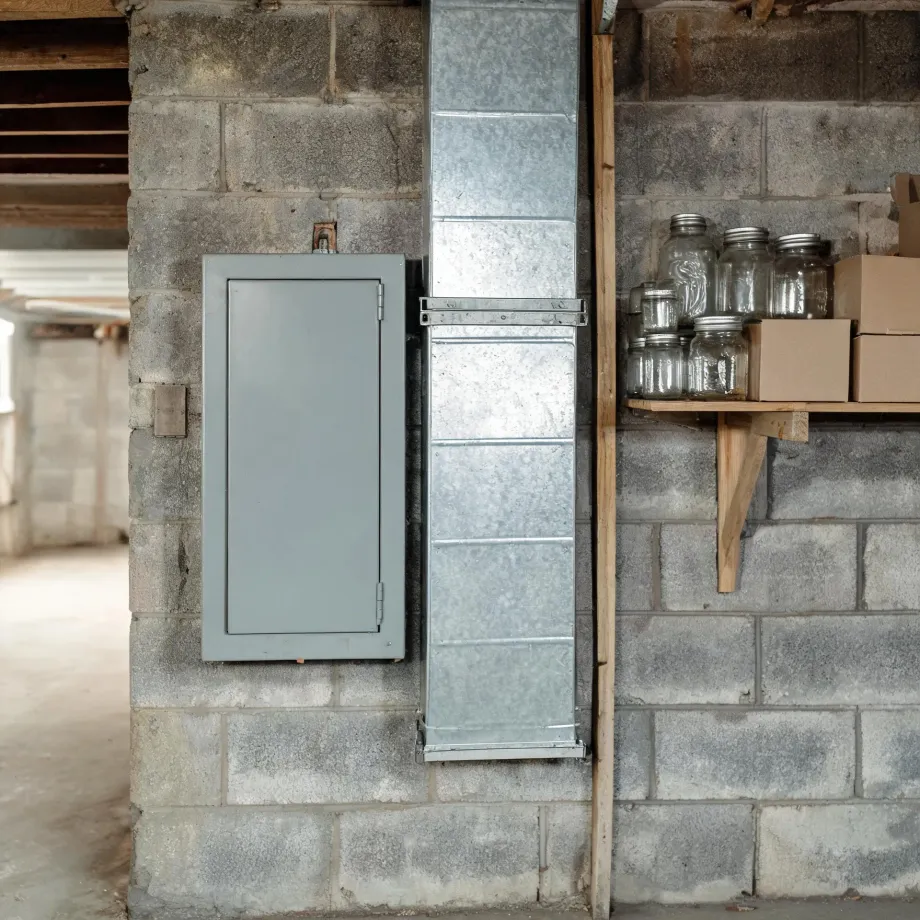
Ductwork laid out for a previous generation of heating rarely matches what a modern boiler needs in distribution and flow. Half the homes in Osage County, Kansas were built in 1974 or earlier (2020-2024 ACS 5-year). A contractor pricing a boiler installation here has to walk the existing pipe runs, check clearances, and decide what stays and what gets rerouted before the equipment itself is even on order. What that inspection turns up is what sets the real scope of the job.
What Gets Installed With a New Boiler
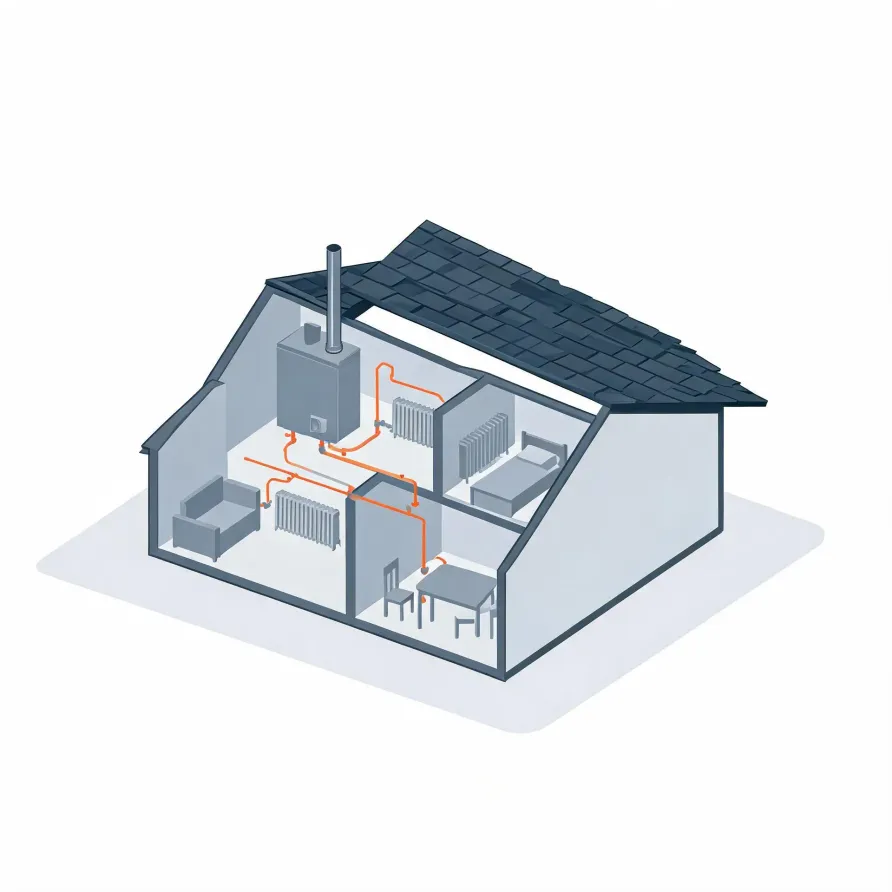
The boiler itself sits in a utility room, basement, or mechanical closet and is the unit that heats water and sends it through the house. Alongside it, the expansion tank mounts nearby and absorbs pressure changes as water heats and cools. The circulator pump, also near the boiler, pushes the heated water through the system.
From the boiler, supply pipes run through the house to the heat emitters, which are the radiators or radiant floor loops visible in each room. Return pipes carry cooled water back to the boiler to be reheated. A thermostat mounts on a wall and tells the system when to fire.
The drawing shows a typical layout, and a licensed contractor determines what applies to this particular house.
Find a contractor in Osage CountyOsage County, Kansas, by the numbers
157 severe weather events were recorded in Osage County, Kansas between 2015 and 2024.
NOAA National Centers for Environmental Information, Storm Events Database, bulk CSV export, events 2015-01-01 through 2024-12-31.Half the homes in Osage County, Kansas were built in 1974 or earlier (2020-2024 ACS 5-year).
U.S. Census Bureau, 2020-2024 American Community Survey 5-Year EstimatesOsage County, Kansas holds 7,337 housing units (2020-2024 ACS 5-year).
U.S. Census Bureau, 2020-2024 American Community Survey 5-Year EstimatesOwners occupy 82.4% of the occupied homes in Osage County, Kansas (2020-2024 ACS 5-year).
U.S. Census Bureau, 2020-2024 American Community Survey 5-Year EstimatesSevere Weather Events in Osage County
Kansas weather puts real demands on heating equipment, and those demands vary by where you are. Knowing what Osage County sees over time helps a contractor size and install a boiler that holds up to local conditions, not just average ones.
157 severe weather events, 2015–2024. Source: NOAA National Centers for Environmental Information, Storm Events Database.